
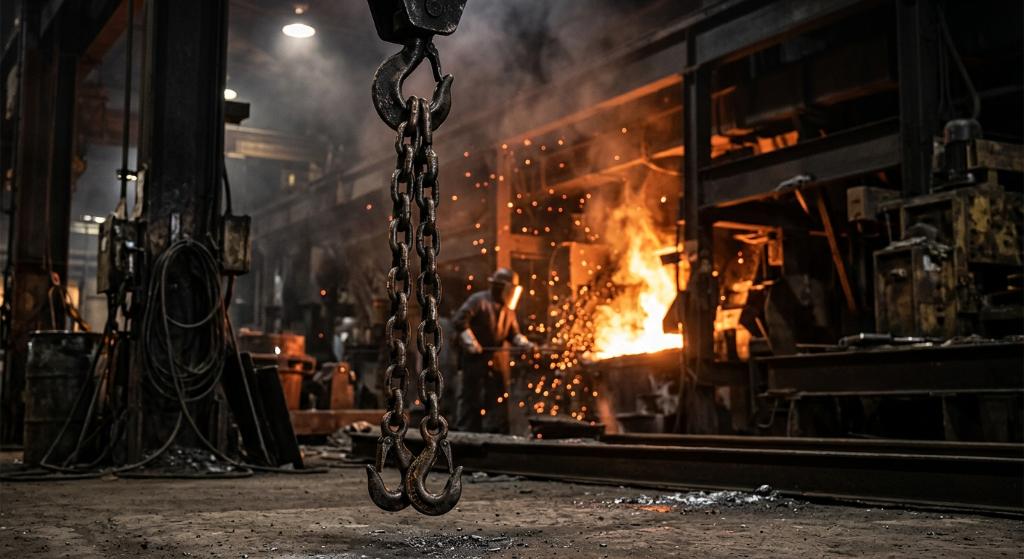
The three main types of lifting slings are chain slings, wire rope slings and synthetic slings (flat webbing slings and round slings). Chain slings suit hot, heavy and abrasive work. Wire rope offers high strength for its weight. Synthetic slings protect delicate or polished loads.
A lifting sling is the flexible link between a crane hook and the load. Choosing the wrong one can damage the load, the sling or the people around it. This guide compares each type, explains how hitches and sling angles change capacity, and sets out what South African law requires.
Chain vs wire rope vs webbing slings: which should you use?
Each sling type suits different loads and site conditions.
| Sling type | Best for | Strengths | Watch out for |
| Chain sling (alloy steel) | Foundries, steel erection, abrasive or hot loads | Most durable; adjustable leg length; available in 1- to 4-leg sets | Heavy to handle; can mark soft or finished surfaces |
| Wire rope sling | Heavy machinery, structural steel, high-capacity lifts | High strength for its weight; some flexibility | Kinks, crushing, broken wires and bird-caging |
| Flat webbing sling (synthetic) | Painted, polished or fragile loads; pipes and panels | Light, soft, wide bearing surface | Cuts on sharp edges; heat and chemical damage |
| Round sling (synthetic) | Awkward shapes; loads needing a soft, flexible wrap | Load-bearing core inside a protective cover | Damage to the inner core can be hidden by the cover |
Chain slings
Alloy steel chain slings are the workhorse of industrial rigging. They tolerate rough handling better than any other type, and shortening hooks let riggers balance an uneven load. Only alloy (high-tensile) lifting chain should be used for slings, never ordinary transport or hardware chain.
Wire rope slings
Wire rope slings are made from steel strands with pressed-ferrule or spliced eyes. They carry high loads at a lower weight than equivalent chain. They must not be bent tightly around small-diameter edges, which permanently damages the rope.
Synthetic slings (webbing and round slings)
Polyester is the most common material. Synthetic slings are light enough for one person to carry and gentle on finished surfaces. Polyester resists most acids but is damaged by alkalis, so check the manufacturer’s chemical guidance before using one in a plant environment. Always fit edge protection over sharp corners.
Lifting sling colour codes, hitches and angles
A sling’s rated capacity only applies in a straight vertical lift. Hitch type and leg angle both reduce what it can safely carry.
Webbing and round sling colour code
Under EN 1492-1 (webbing slings) and EN 1492-2 (round slings), sling colour indicates the vertical working load limit:
| Colour | WLL (vertical) |
Violet Green Yellow Grey Red Brown Blue Orange | 1 t 2 t 3 t 4 t 5 t 6 t 8 t 10 t and above |
Colour is a quick visual check, not proof of capacity. The stitched label is the authority. A sling with a missing or unreadable label should be taken out of service.
How the hitch changes capacity
- Vertical hitch: the full rated WLL.
- Choke hitch: the sling wraps and tightens around the load. For EN 1492 textile slings, the choke factor is 0.8, so capacity drops to 80%.
- Basket hitch: the load sits in a U-shaped sling. With both legs vertical, the factor is 2.0. It falls as the legs spread apart.
Why sling angle matters
The wider the angle between two sling legs, the more tension each leg carries. At a 120° included angle, each leg carries the full weight of the load.
| Angle between legs | Tension in each leg (as % of load) |
0° (vertical) 60° 90° 120° | 50% 58% 71% 100% |
Keep the included angle at 90° or less where possible, and never exceed 120°.
What does South African law require for lifting slings?
In South Africa, slings are “lifting tackle” under Regulation 18 of the Driven Machinery Regulations, 2015 (Occupational Health and Safety Act 85 of 1993). The regulation requires that every item of lifting tackle:
- is clearly marked with its safe working load and traceable identification;
- meets minimum safety factors: 7 for man-made fibre ropes and woven webbing, 6 for steel-wire ropes, and 4 for high-tensile or alloy steel chains;
- is inspected by a competent person, appointed in writing, at intervals not exceeding three months, with results recorded and signed; and
- is discarded if it shows any sign of damage, defect, wear or distortion.
Good practice is for the rigger to check every sling before each use as well. Our lifting equipment inspection checklist covers what to look for.
Need help choosing the right sling for a lift?
Reef Rigging plans and executes heavy lifts, machinery moves and installations across South Africa. Our team selects and inspects the right lifting tackle for every job. Call +27 82 659 3315 or contact us to discuss your project.
Frequently asked questions
How long does a lifting sling last?
There is no fixed lifespan. A sling stays in service only while it passes inspection and its label is legible. Heavy use, heat, UV and chemicals shorten its life.
Can a damaged webbing sling be repaired?
No. A cut, burnt or torn synthetic sling must be discarded. Never tie a knot in any sling to shorten or repair it, as knots greatly reduce strength.
Which sling is best for hot loads?
Alloy steel chain. Synthetic slings lose strength at high temperatures. Always check the manufacturer’s temperature rating.
How should lifting slings be stored?
Clean and dry, off the ground and hung on a rack, away from heat, direct sunlight and chemicals.